This Independence Day, Read Matthew Hale
Sir Matthew Hale’s History of the Pleas of the Crown (1736) has today become (in)famous because of its use in both Roe v. Wade (1973) and Dobbs v. Jackson Women’s Health (2022). The only other use modern courts have had for Hale’s Pleas is to criticize as “misogynist” his historically innocuous observation that rape accusations are easy to make, less easy to prove, and hard to rebut, and more so within marriage. That and Hale’s equally innocuous (and biblical) assumption that witches are real.
Needless to say, the American founders had greater use for Hale (“the man who hated women,” as one post-Dobbs commentator put it) than today’s feminists, and more appropriate regard for him as a common law authority. It is apparent that Hale was ubiquitous in the founding generation and that it was assumed that learned men were acquainted with him.
In 1760, John Adams recorded reading Hale’s History of the Common Law with great pleasure, though he was evidently frustrated with the confused Greek on the frontispiece, a fault of the printer. At some point, Adams also acquainted himself with the Pleas and cited it liberally in Preston’s Case.
Thomas Jefferson too was well acquainted with Hale, albeit not affectionately. In his famous correspondence with Adams, the aged master of Monticello castigated Hale for his declaration in Taylor’s Case (1675) of the maxim that Christianity was part of the common law. This did not negate Hale as an authority on other things, even to Jefferson.
Adams indulged Jefferson’s inquiry but was apparently less offended by Hale’s maxim than he was apprehensive about any potential source of national division. Adams’ comments remind us just how tenuous unity was but also how religious Americans were and how religion and politics are never separable.
“Your research in the Laws of England, establishing a Christianity as the Law of the Land and part of the common Law, are curious and very important. Questions without number will arise in this Country. Religious Controversies, and Ecclesiastical Contests are as common and will be as Sharp as any in civil Politicks foreign, or domestick? In what Sense and to what extent the Bible is Law, may give rise to as many doubts and quarrells as any of our civil political military or maritime Laws and will intermix with them all to irritate Factions of every Sort. I dare not look beyond my Nose, into futurity. Our Money, Our Commerce, our Religion, our National and State Constitutions, even our Arts and Sciences, are So many Seed Plott’s of Division Faction , Sedition and Rebellion. Every thing is transmuted into an Instrument of Electioneering.”
Rufus King had read Pleas, and assumed that Alexander Hamilton either had or could access it. John Trumbull paraphrased Hale’s standard of proof for murder, adding that he had discovered no precedent of punishment for “self-murder.” James Madison recommended that Hale’s works, along with Coke, Blackstone, Glanville, Bracton, and Fortescue be included in the library of Congress. Here we have something of the curriculum for lawyers and legislators in the early republic.
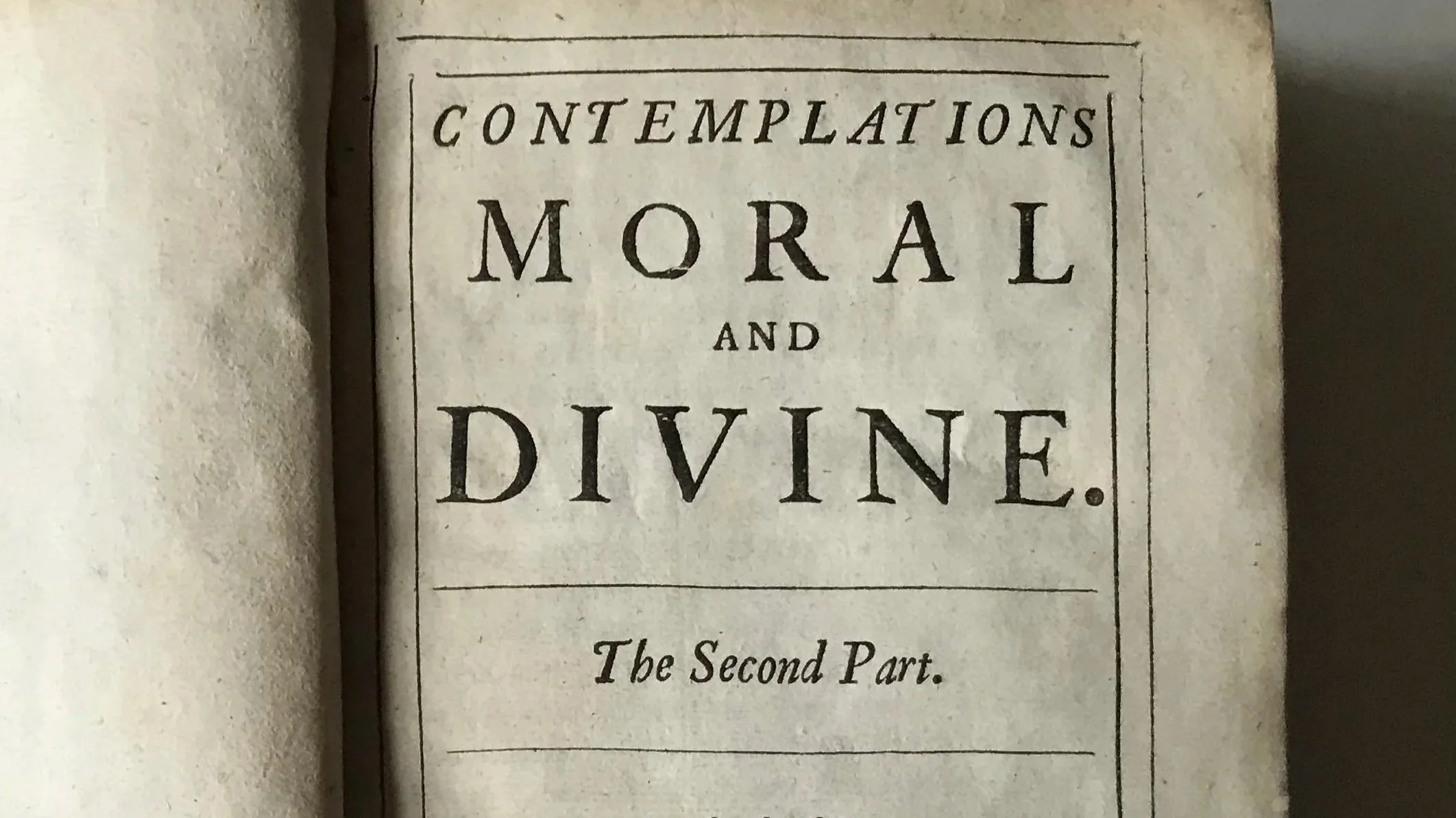
Hale’s legal commentary was not the only thing in circulation in early America. It is no surprise that we find Hale’s Contemplations Moral and Divine in George Wasington’s library given its immense popularity and that, per Washington Irving, the first president’s mother reared him and his siblings on Hale’s manual in the absence of a father. The Contemplations is a collection of Hale’s post-sermon Sabbath reflections. The work begins with the reminder from Job 28 that the fear of God is the beginning of wisdom. Acquisition of this wisdom begins with consideration (in a “deep sense”) of the attributes of God, his majesty, goodness, omniscience, holiness, and justice. No wonder Washington spoke so often of Providence.
Such knowledge induces fear but does not supply the means of obedience. For that, we must look to God’s revelation both of himself and of our duties to him:
“But although this knowledge of GOD may justly excite a fear both of reverence and caution, yet without the knowledge of something else, that fear will be extravagant and disorderly. If a man know that God is just, and will reward obedience and punish disobedience; yet if he knows not what he would have done or omitted, he will indeed fear to displease him, but he will not know how to please, or to obey him: therefore besides the former there must be a knowledge of the will of GOD in things to be done or omitted. We have an excellent transcript of the divine will in the Holy Scriptures; which therefore a man that fears God will study, and observe, and practice.”
In Hale, we have a glimpse into what a fatherless, fourteen-year-old Washington was instructed to do and believe. Next comes the “knowledge of Christ crucified.”
Perhaps the History of the Pleas of the Crown is not your cup of tea. Rather than hurling Hale into the harbor this Independence Day, take up his Contemplations. Not all of us need to be barristers, but surely, we could all do with a dose of the moral and theological formation that our national father received.